BLOG CATEGORIES

Page 2 - GT

  1. Let Your Ponies Be Heard - Exhaust Component R&D, Part 2: The H-Pipe

    Let Your Ponies Be Heard - Exhaust Component R&D, Part 2: The H-Pipe

    After coming up with a game plan we were ready to tackle the first portion of the Mustang GT exhaust, the resonator. We began this exhaust project a bit differently than projects in the past, we began with the waterjet.

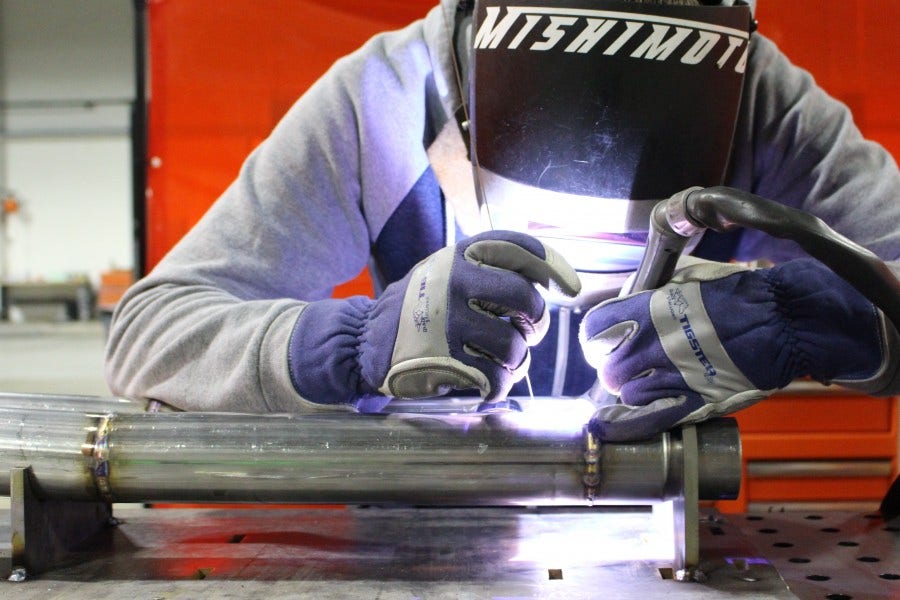
    How, you might ask, are we going to produce a prototype made of piping on the waterjet? We're not! To save time and improve accuracy, we will use a jig to create the first prototype H-pipe and X-pipes. Our hopes are that they will provide more precise prototypes that need less revision, therefore saving time. We will also use the same jig for production, so that each resonator delete produced will have the same great fitment as the prototype that we create.

    With that said, we fired up the waterjet and began cutting our jig.
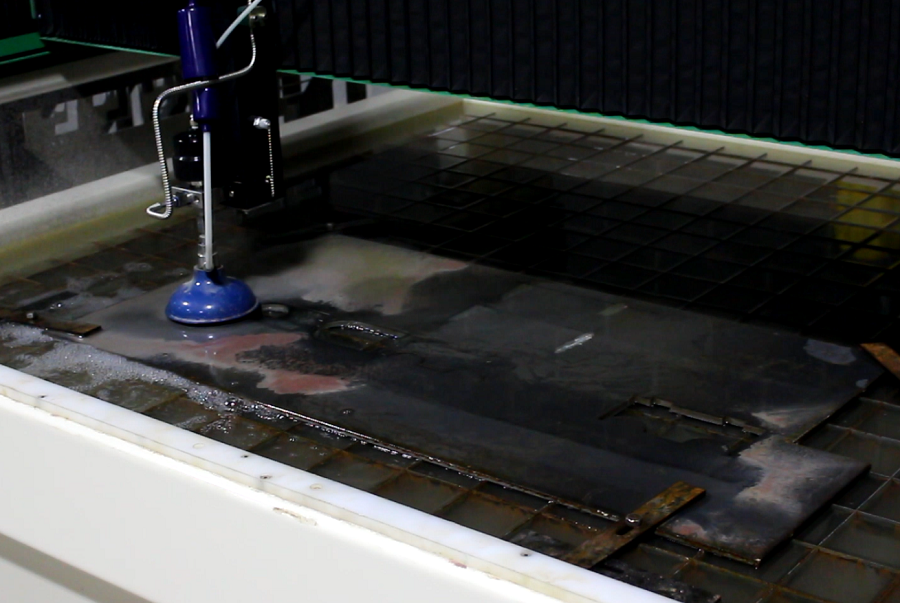
    Cutting our Mustang H-pipe jig on the waterjet
    Cutting our Mustang H-pipe jig on the waterjet

    Creating the Prototype

    These first pieces of the jig are specific for our H-pipe. We will use the jig as a tool to map the path that our H-pipe needs to take in order to fit perfectly on our GT.

    Mustang H-pipe pieces resting in the jig
    Mustang
    Continue Reading »
  2. Let Your Ponies Be Heard - Exhaust Components R&D, Part 1: Stock Evaluation

    Let Your Ponies Be Heard - Exhaust Components R&D, Part 1: Stock Evaluation

    At Mishimoto, our job is to bring you more than just exceptional cooling products. Another product category that we offer is exhausts, and what better car for an exhaust project than the fantastic-sounding Mustang GT!

    The stock system on the Mustang GT sounds pretty darn good as is, but after inspection we found some ways that we could improve on the stock design. If you aren't familiar, here are some photos of the stock Mustang GT exhaust.

    Stock Mustang GT exhaust Stock Mustang GT exhaust

    Stock Mustang GT exhaust Stock Mustang GT exhaust
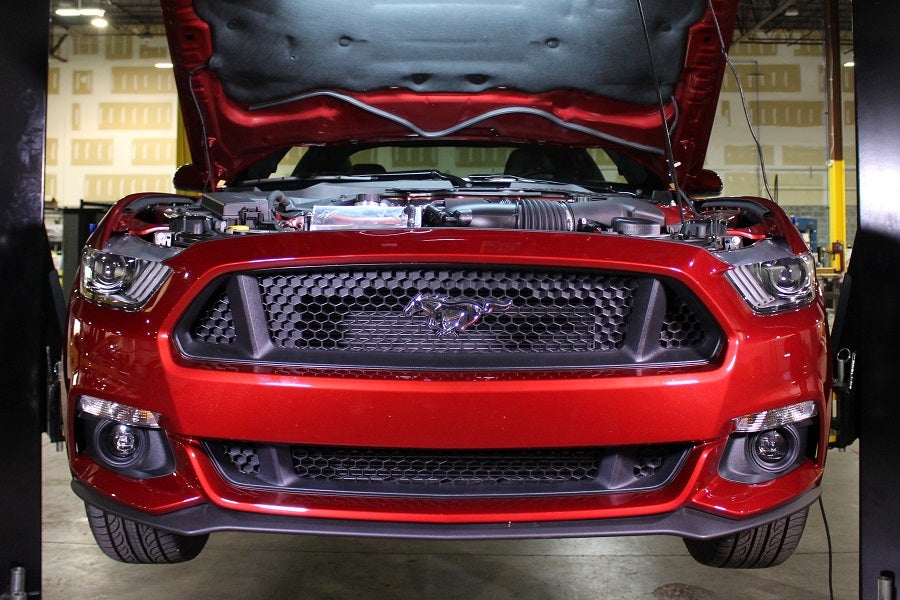
    The stock exhaust manifolds exit into two catalytic converters, one of which is integrated into the exhaust manifold itself. Is this Ford's way of deterring the installation of aftermarket headers? The world may never know. The exhaust is 2.25" in diameter from the exhaust manifolds all the way through the resonator that you see in the photos. After the resonator the diameter of the exhaust jumps back up to 2.5". The pipes then snake past the rear differential into two mufflers at the rear with a single

    Continue Reading »
  3. Keep oil out of your intake - Oil Catch Can R&D, Part 3: Test Results

    Keep oil out of your intake - Oil Catch Can R&D, Part 3: Test Results

    In our last two posts we took a look at the prototype catch can brackets and hoses for both the driver and passenger-side. As a recap and to better explain our results, the next paragraph describes the crank case ventilation systems on the Mustang GT. If you're not in a reading mood feel free to continue to the results below.

    Crank Case Ventilation on the Mustang GT

    While we can continue to refer to the two catch can systems as the driver and the passenger-side, we can also differentiate them another way. This will allow us to better understand the results of our testing. The passenger-side catch can is tapped into the ventilation line that allows crankcase air (and blow-by) to exit the engine. We often call this the positive crankcase ventilation, or PCV line. This line is equipped with a valve, referred to as the PCV valve, which works to regulate the air flowing through the crank case ventilation (CCV) system. The driver-side catch can is tapped into a simpler breather line referred

    Continue Reading »
  4. Working on a cooler Coyote - Oil Cooler R&D, Part 1: Initial Prototype

    Working on a cooler Coyote - Oil Cooler R&D, Part 1: Initial Prototype

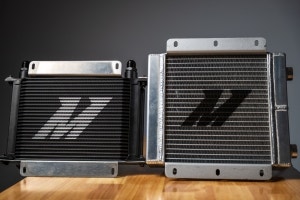
    Here at Mishimoto headquarters we are working to expand our arsenal of Mustang parts. We are making significant progress on our oil cooler design, and an interesting design it is. We are aware that many Mustang GT owners are adding forced induction to their already powerful V8s. We are taking this into account by offering an oil cooler that would still leave room for some of the larger intercoolers required for aftermarket turbo and supercharger kits. This strategy created quite a challenge for our engineers. As always, they rose to the occasion and created a brand new and unique cooler design specifically for our beloved GT. Drumroll please!

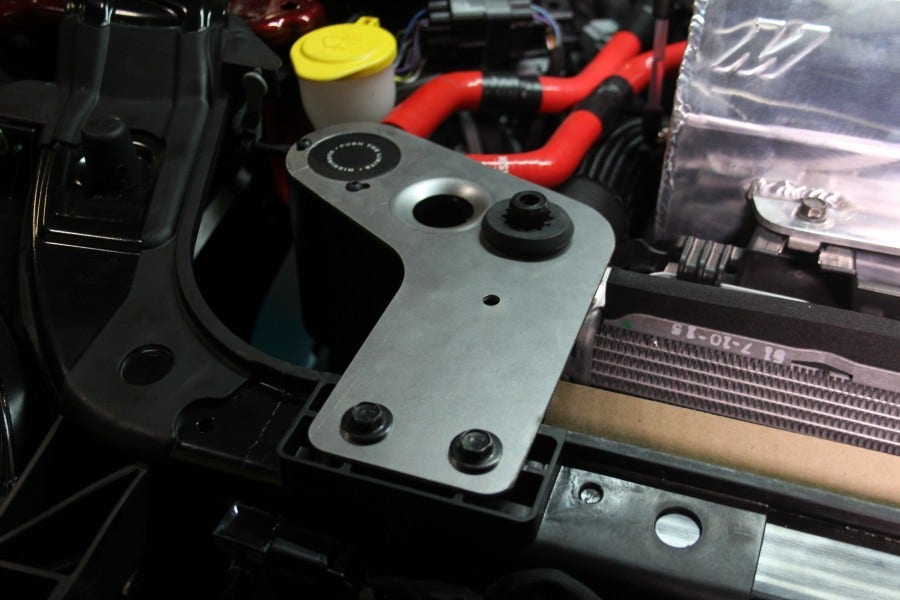
    Rather than designing a traditional bracket for this all-new oil cooler, our engineers went with an interesting design. Modeling the bracket after one of the plastic upper air diverters, the new bracket will replace the diverter as the bracket for the cooler. Because a picture really is worth a thousand words, check out some photos of the first oil

    Continue Reading »
  5. Keep Oil Out of Your Intake - Oil Catch Can R&D, Part 2: The Driver-Side

    Keep Oil Out of Your Intake - Oil Catch Can R&D, Part 2: The Driver-Side

    Last time we took a look at the passenger-side catch can setup for our brand-new Mustang GT. We will still be making more improvements to our original design going forward, but the main location will stay the same. Now onto our driver-side catch can development!

    Driver-side Mustang catch can bracket installed
    Driver-side Mustang catch can bracket installed

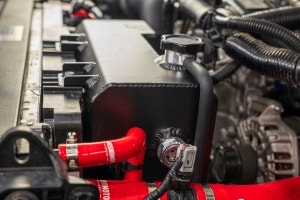
    Driver-side Mustang catch can installed
    Driver-side Mustang catch can installed

    The driver-side catch can was a bit more difficult to place than the passenger-side catch can. We wanted to position the catch can such that it would fit with the rather intricate stock intake, while still leaving room for aftermarket intakes. Our engineers utilized the radiator stay, similar to the passenger-side, to tuck the catch can off to the side and out of the way, thus saving room for some additional Mustang parts.

    Driver-side Mustang catch can bracket installed
    Driver-side Mustang catch can bracket installed

    Routing of driver-side Mustang catch can hoses
    Routing of driver-side Mustang catch can hoses

    Although we do not expect to see much accumulation in the driver-side catch can, we will still test it for comparison purposes.

    Continue Reading »
  6. Keep oil out of your intake - Oil Catch Can R&D, Part 1: Blow-By Introduction

    Keep oil out of your intake - Oil Catch Can R&D, Part 1: Blow-By Introduction

    The 2016 Mustang GT has arrived at Mishimoto, and we are wasting no time in developing products for Ford's newest version of the Pony car. We decided to begin with a version of our baffled oil catch can specifically designed to be direct-fit with the Mustang GT.

    Stock Mustang Parts
    Stock Mustang Parts

    You would be doing your Coyote a favor by installing some type of catch can for preventative maintenance. Some feel that a catch can is not a necessity until you introduce forced induction, which may be the case. On the other hand every ounce of blow-by collected in a catch can is an ounce that is not heading back into your intake to kill fuel mileage, buildup on valves, and increase the risk of detonation. To read more about the benefits of a catch can in depth, check out our complete write up on Blow-By 101.

    Mishimoto's Baffled Oil Catch Can was designed to trap virtually all blow-by from sneaking its way back into your intake. Our can is equipped with internal air diverters to direct airflow, a large baffle

    Continue Reading »