BLOG CATEGORIES

chassis

  1. American Workhorse - Part 1: Minimizing Chassis Flex

    American Workhorse - Part 1: Minimizing Chassis Flex

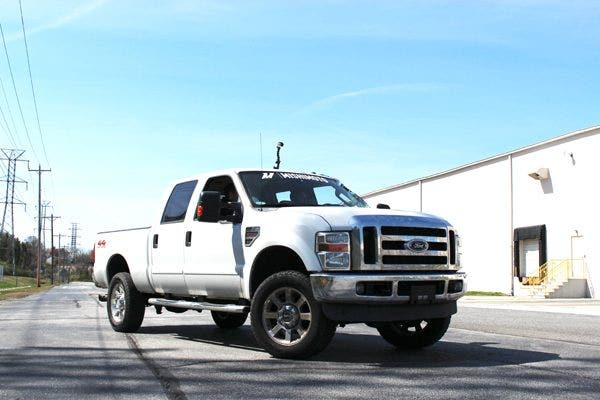
    As a proud American company, Mishimoto is dedicated to supporting our workforce and ensuring that, from a vehicular perspective, we've got the best tools possible to stay tough and work hard. That's why we've been hard at work developing a sturdy, heavy-duty upper radiator support bar for the Ford 6.4L Powerstroke truck in hopes that it can still live up to its reputation as the workhorse of America.
    IMG_4606

    A View From Above

    Industry, manufacturing, and innovation are the driving forces that made our United States of America so grand. Hard work, great design, and our invaluable freedom to innovate planted the seeds that sprouted into our wonderfully advanced society. There is, perhaps, no better place to observe the fruits of our industrial and technological prowess than from the top of a skyscraper, gazing upon the furthest reaches of our developed urban expanse. These myriad buildings are monuments to the hardworking Americans who built the foundations of our country literally from the ground
    Continue Reading »
  2. Flex-Free Cornering. Fiesta ST Trunk Brace R&D, Part 4: Testing Data

    Flex-Free Cornering. Fiesta ST Trunk Brace R&D, Part 4: Testing Data

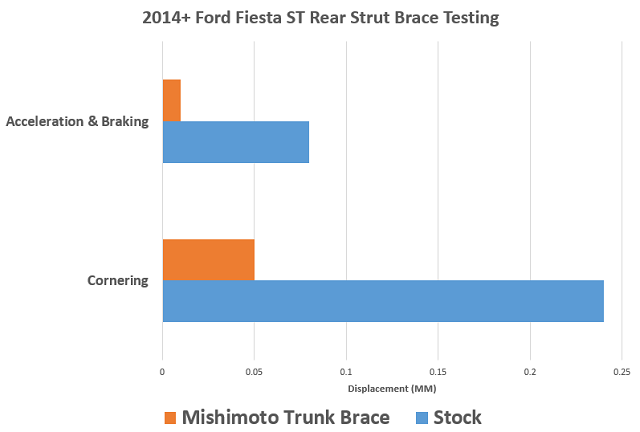
    The testing of our Fiesta ST rear strut brace involved three different driving conditions.

    Cornering: 30-40 mph, slalom

    Braking: 50-0 mph, stop with ABS engaged

    Acceleration: 0-60 mph, full-throttle run

    Each setup (with and without brace) was tested on the same day on an identical surface and with the same driver. The tests are repeatable and will provide an accurate comparison of rigidity in the rear body portion of our Fiesta.

    Results

    Check out the plot below to see our testing results.

    Fiesta ST performance results
    Fiesta ST performance results

    These data points confirm our theory that the addition of bracing in this area of the ST does indeed have an impact on flex. Although flex in these conditions was not excessive, we did see a bit of movement.

    Once the trunk brace was bolted into place, the results were very impressive; the brace reduced overall movement substantially. The acceleration and braking test saw less overall movement compared to our handling test. Movement during the acceleration and braking conditions

    Continue Reading »
  3. Flex-Free Cornering. Fiesta ST Trunk Brace R&D, Part 3: Functional Prototype and Test Rig

    Flex-Free Cornering. Fiesta ST Trunk Brace R&D, Part 3: Functional Prototype and Test Rig

    In our last update, we left you with some mock-up prototype pieces that we used to create and refine our Fiesta ST rear strut brace design. Since then, we've worked up a couple of functional prototypes to test our ideas for stiffening the rear of this hot hatch.

    Initial Prototypes

    We constructed two prototypes of this trunk brace. The first prototype is finished in a black powder coat, and we'll use this unit to evaluate for aesthetics and fitment. The unfinished ("raw") prototype is going to be used for testing purposes, meaning it will be modified.

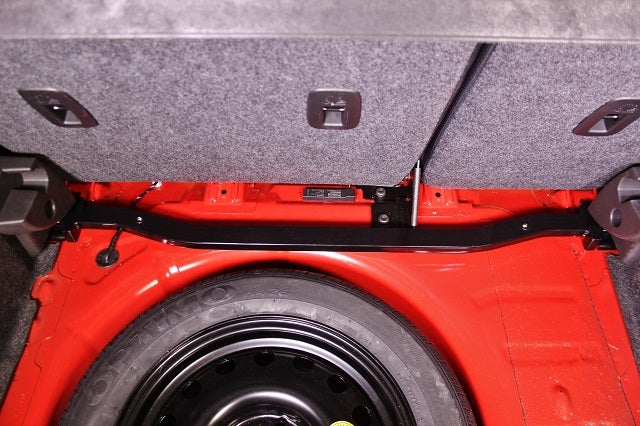
    First, check out our powder-coated unit bolted into place.

    Mishimoto Fiesta ST performance parts
    Mishimoto Fiesta ST performance parts

    Mishimoto Fiesta ST performance parts
    Mishimoto Fiesta ST performance parts

    Everything fit nicely and bolted into position as designed. Check out a close-up shot of fitment with the lower tray support.

    Mishimoto Fiesta ST parts
    Mishimoto Fiesta ST parts

    With the lower tray in place the bracing is barely visible.

    Mishimoto Fiesta ST parts
    Mishimoto Fiesta ST parts

    Although this unit fit well and is extremely robust, we are going to make

    Continue Reading »
  4. Flex-Free Cornering. Fiesta ST Trunk Brace R&D, Part 2: Prototype Completion

    Flex-Free Cornering. Fiesta ST Trunk Brace R&D, Part 2: Prototype Completion

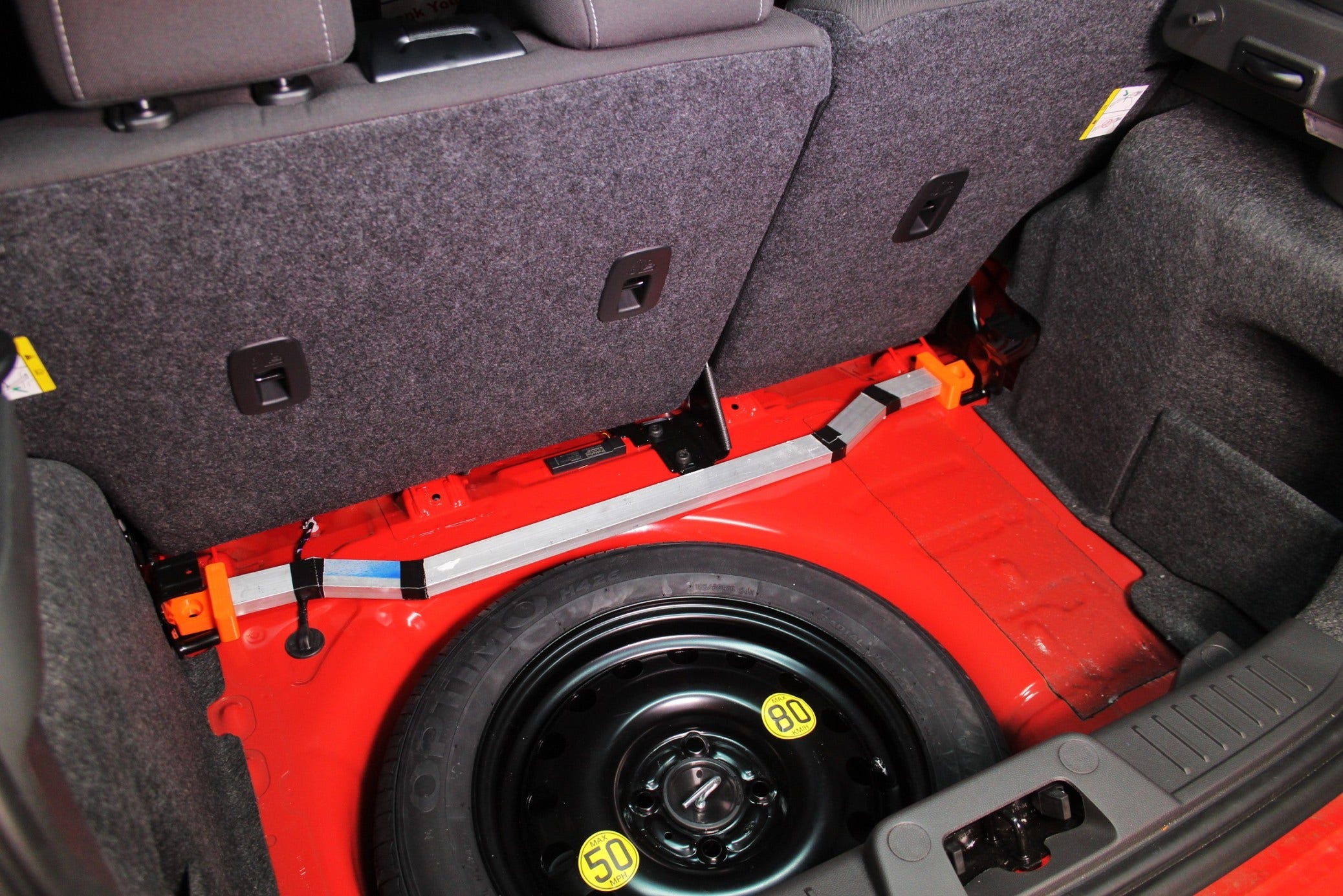
    We left off development with a neat look at our first prototype, when we determined the shape and path of our brace and printed out mounting brackets for each side of the piece. By using specific angles with our square material, we were able to avoid modification of the seat mounting bracket, retain rigidity, and provide a bar that is easily hidden by the rear tray.

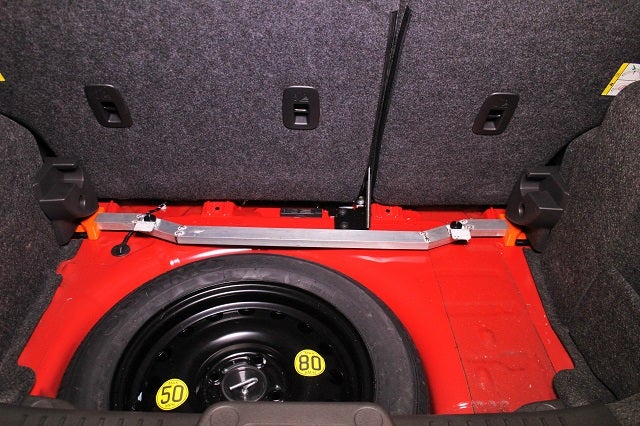
    Our last image showed our fabricator tacking together the material. Below is what we ended up with.

    Prototype Fiesta ST rear strut brace installed
    Prototype Fiesta ST rear strut brace installed

    We then installed the floor panel mounting covers.

    Prototype Fiesta ST rear strut brace installed
    Prototype Fiesta ST rear strut brace installed

    Let's take a closer look at how the plastic interior components sit with respect to our brace mounts.

    Prototype Fiesta ST rear strut brace installed
    Prototype Fiesta ST rear strut brace installed

    As you can see, the height of our mounts will prevent use of the lower mounting position for the rear tray. We want this bar to allow the tray to fit in both the lower and upper positions, retaining all intensions from the factory design.

    Continue Reading »
  5. Flex-Free Cornering. Fiesta ST Trunk Brace R&D, Part 1: Initial Prototype Design

    Flex-Free Cornering. Fiesta ST Trunk Brace R&D, Part 1: Initial Prototype Design

    Chassis rigidity is extremely important for on-track handling, response, and feel. Ford provides a well-designed chassis with the Fiesta; however, as you can imagine, there is always room for improvement. Within the short time that this car has been available, the aftermarket has provided some great options, including better dampers, stiffer springs, and thicker sway bars, to enhance handling.

    Our company will not likely dip into struts or springs, but we are certainly interested in helping stiffen the chassis. Our Mustang EcoBoost front strut tower brace is underway, and we recently launched development of a Fiesta ST rear strut brace. Time to get started!

    What's The Plan?

    Our goal here is to link one side of the rear trunk area to the other. You may wonder why this is needed. Doesn't the floor/body connect the two sides? Yes, but keep in mind, the floor is not made from a thick material. During aggressive cornering, the floor will see some pretty substantial flex. By connecting one side

    Continue Reading »